A 12-week study by Gurjeet Birdee and colleagues from Vanderbilt University Medical Center, Vanderbilt University, and Yoga Well investigated whether progressively slowing the breath through yoga-based breathing exercises was associated with changes in blood pressure and autonomic function. The findings provide an intriguing look at the potential cardiovascular effects of regular pranayama-style breathing.
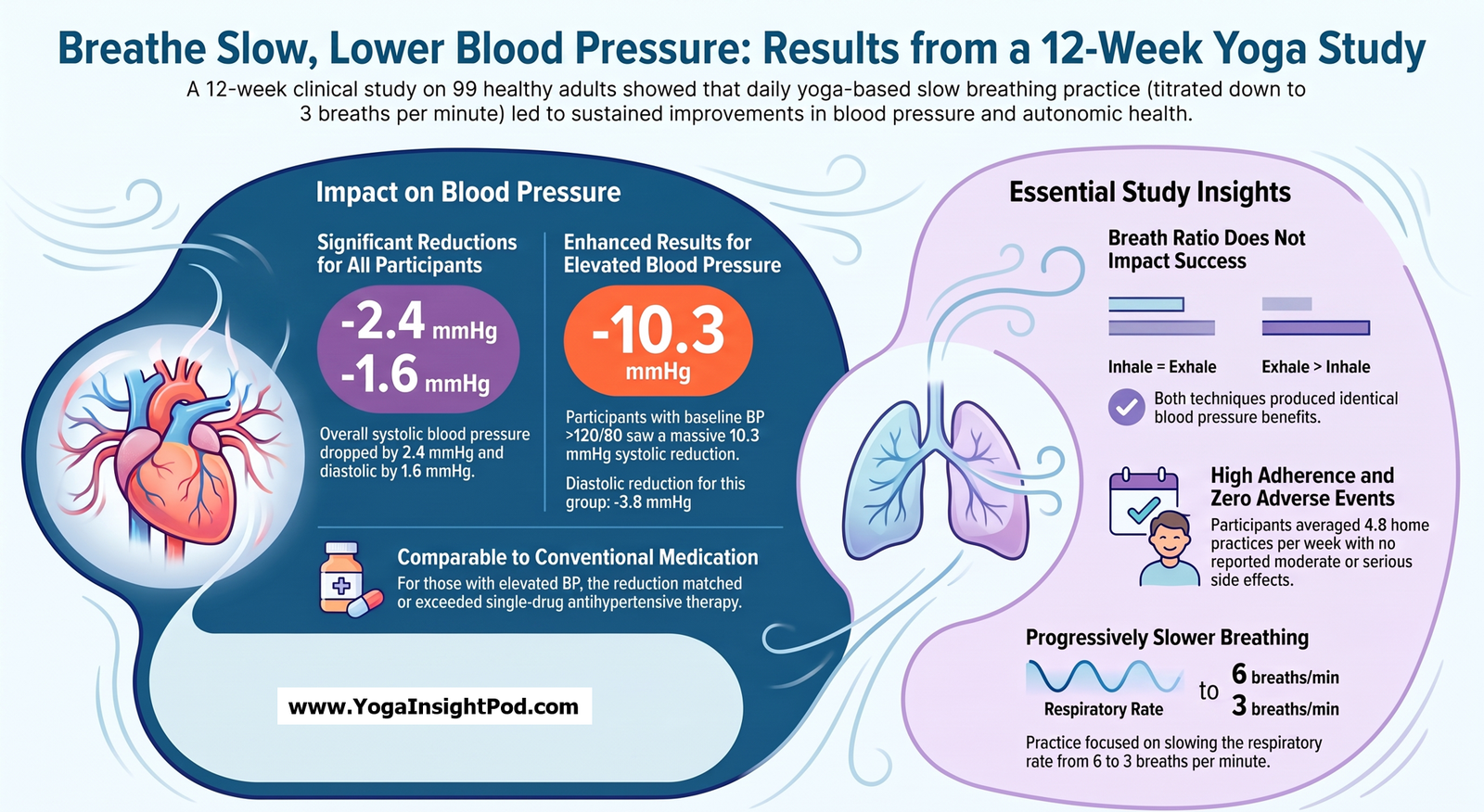
Researchers analyzed data from 99 generally healthy adults who participated in 12 weeks of yoga-based slow breathing. Participants received individualized instruction and were randomized to either equal-length inhalation and exhalation (I = E) or a breathing pattern in which the exhalation was longer than the inhalation (E > I). Rather than prescribing one fixed breathing rate, the program progressively slowed each participant's breathing toward the slowest comfortable rate. Participants averaged approximately 6 breaths per minute during week one and about 3 breaths per minute by week twelve. Adherence was high, averaging 10.7 of 12 instructional sessions and about 4.8 home practices per week. After 12 weeks, systolic blood pressure decreased by an average of 2.4 mmHg and diastolic pressure by 1.6 mmHg across participants. Among the 11 participants who began with elevated blood pressure, the reductions were larger: approximately 10.3 mmHg systolic and 3.8 mmHg diastolic.
Interestingly, the longer-exhalation technique did not produce greater blood-pressure reductions than equal inhalation and exhalation. Nor did the researchers detect significant changes in autonomic tone using spectral heart-rate and blood-pressure variability measurements. The findings are promising, but important limitations remain: this was a secondary analysis, there was no non-breathing control group, and people diagnosed with hypertension were excluded. Larger controlled trials are therefore needed.