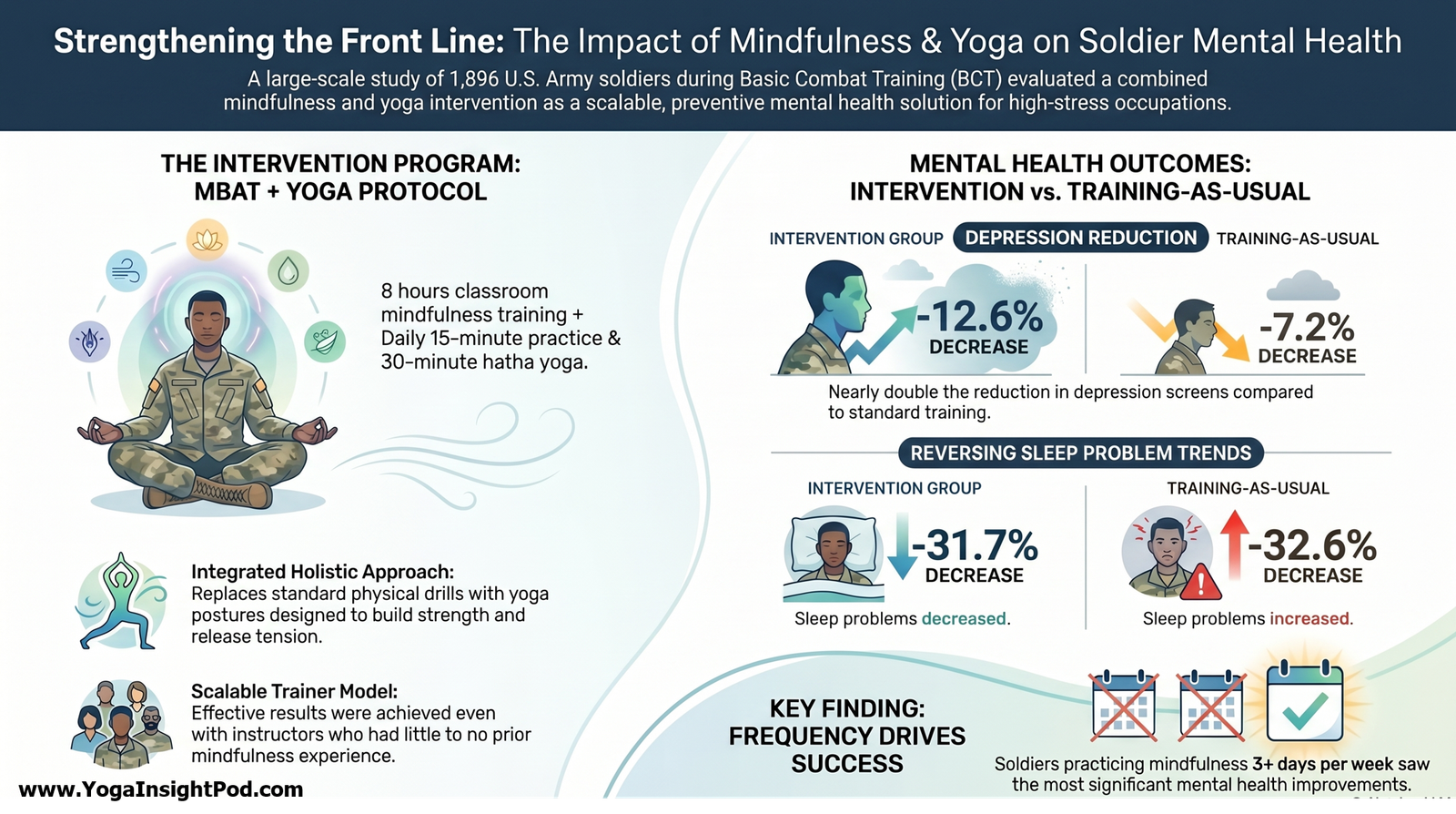
A large U.S. Army cluster randomized trial in Basic Combat Training conducted by Thomas H Nassif and team at Walter Reed Army Institute of Research found that an embedded mindfulness plus yoga program led to faster reductions in depression and sleep problems compared with standard training. The scalable protocol, delivered by non-specialist instructors, suggests a practical path to primary mental health prevention in high-stress occupations.
Basic Combat Training (BCT) is one of the most intense psychological and physical challenges soldiers face, and rates of depression, anxiety, and sleep problems are high during this period. To test a scalable prevention strategy, the U.S. Army conducted a cluster randomized controlled trial with 1,896 soldiers in BCT, assigning entire platoons either to training-as-usual or to a combined mindfulness and yoga program integrated into the training schedule.
The intervention included a manualized Mindfulness-Based Attention Training (MBAT) course four weekly 2 hour classroom sessions plus 15 minute guided audio practices six days a week together with embedded postural yoga delivered during Physical Readiness Training. Mindfulness components emphasized breath awareness, body scanning, open monitoring, and interpersonal connection, while yoga emphasized physical postures and breathing techniques suited to the military environment. Instructors were performance experts with little prior mindfulness experience, suggesting the model was realistically trainable and scalable.
Over the 10 week BCT cycle, soldiers in the mindfulness and yoga condition showed a faster reduction in positive screens for depression and sleep problems compared with the training-as-usual group, indicating better mood and sleep health under sustained stress. Anxiety symptoms decreased over time in both groups, likely reflecting adaptation to the novel demands of BCT, but did not differ significantly by condition. Importantly, more frequent embedded mindfulness practice during the training day was associated with fewer positive mental health screens, underscoring the value of bringing short, in the moment practices into real work contexts rather than relying on classroom sessions alone.
The authors conclude that a combined mindfulness and yoga intervention is a feasible, scalable primary-prevention strategy to support soldier mental health in high-risk, high-demand settings, with potential relevance for other occupations such as health care workers and first responders.